Thursday, June 28, 2007

Time Travels


Greetings to all! I hope everyone is having a peaceful and productive summer. I am in the first month of a year long sabbatical so thought I would keep in contact with the CS blog by reporting in now and then from my assorted excursions. I am traveling a bit and last week was fortunate to connect with my friend in Los Angles, Marilyn Slater, who is author of the amazing website on the silent film star, Mabel Normand, http://www.freewebs.com/looking-for-mabel/. For our evening adventure, we visited the still vibrant LA institution, Silent Movie Theatre (http://www.silentmovietheatre.com/movies/), which has new owners committed to showing silent film once a week with live accompaniment. It was a great evening with three beautiful prints (including the King Vidor feature, The Crowd), some wonderful music, and even the family of King Vidor in attendance, who shared some info on the film and director. A big shout out to those doing their part to keeping this important part of our media culture alive. It reminded me how much cinema has always been a transmedia or intermedia enterprise and how the idea of live performance was once very much a part of the cinema experience (and is using this element again today in various experimental venues -- as seen in Toni Dove's colloquia talk on interactive cinema in May). These intersections of the live and recorded enhance the cinema's inherent properties of presence and absence -- a doubling of its uncanny spell!

I will be checking back with further reports in time travels -- in the meantime, please check out our links to assorted folks/places of interest. Erik Loyer, one of last year's colloquia speakers, has a brand new website with lots of cool stuff...check it out!
Until next time, my wishes for big sky mind adventures for all of you! I am off to update my music selections! Lots of Coltrane (John and Alice) these days!

Thursday, May 17, 2007


On April 27th the Colloquia in Conceptual Studies series at UWM, which has placed as a central focus the intersection of theory and practice in new media production and interactive art, was graced with the presence of two theorist-practitioners who are currently working through the interstitial territory where – as Ms. Zuniga-Shaw put it – body, site and technology communicate. Nora Zuniga-Shaw is a dance artist and theorist, director of dance and technology and assistant professor at the Ohio State University Department of Dance and in the Advanced Computing Center for the Arts and Design. In addition, she is a founding member of the Emma (Experimental Media and Movement Arts) Lab. (Go to http://accad.osu.edu/Projects/EMMA/ to learn more about this groundbreaking facility.) Luc Vanier is an assistant professor in the Dance Department at the University of Wisconsin-Milwaukee, an accomplished dancer and choreographer, and an associate director of the modern dance company Your Mother Dances, who often incorporates interactive technologies into his productions.

Both foreground the body as a site of knowledge and see dance, at least in part, as a formal way of exploring bodily knowing. Dancers develop thinking, reactive bodies, skill sets which make them particularly helpful in the realm of technological development, where specialists have not traditionally been focused on the physical component of techno-logical encounters. The works shared at the colloquium on Friday dealt specifically with elaborating the communication between expressive human motion and interpretive machines.

Mr. Vanier’s work involves responsive virtual environments made in either Max/MSP and Jitter or Isadora that react via motion capture technologies to dancers’ movement onstage during live performances. Early attempts, in which the interactive patch and the dance were conceived and developed separately, functioned, in this writer’s opinion, merely as elaborate light shows. The main problem was that the connection between the movement onstage and the imagery was not made apparent. These works highlight the importance of fine-tuning a digital instrument to both the site, the human movements and the thematic material involved in order to achieve conceptual and, hence, aesthetic coherence. Even when, in later pieces such as Bob’s Palace, the movement of the dancers very explicitly generated/ affected a live stream of projected virtual imagery, there seemed to be a conceptual disconnect that may simply have to do with a lack of complexity written into the original patch.

Ms. Zuniga-Shaw points out that part of the difficulty in designing these instruments or environments is that it is a relatively new field that requires specialized knowledge from several currently disparate fields. In her theoretical work she discusses the importance of what she terms “interdisciplinarity,” as opposed to multidisciplinarity. Multidisciplinary practice involves the collaboration of specialists from different fields who solve problems that lie within their specific area of expertise. Interdisciplinary practice, on the other hand, is based on a more in-depth dialogue between these often arbitrarily separated kinds of work. This mode of collaboration facilitates greater technical and cultural understanding from the parties involved and leads to technological and artistic innovation. This modus operandi takes a great deal of time, and the establishment of institutes and laboratories that facilitate long-term research is, in her mind, essential. Norah is currently working on, among other projects, an interactive animated score for choreographer William Forsythe's seminal piece "One flat thing, reproduced." An excellent example of an interdisciplinary project, a team of specialists from a variety of fields (including designers, PIXAR animators, computer scientists & engineers interested in subjectivity, philosophers, cognitive scientists and dancers) has been assembled to take on the challenge. Ms. Zuniga-Shaw’s art-practice resembles a sort of creative problem solving. Many solutions to a single problem are attempted, collected and analyzed. Discoveries are made. And, importantly, along the way a new interdisciplinary vocabulary is developed to describe the process and the output. The foundational/ operational aspects of the project inspired such a long discussion that there was not enough time remaining to delve into all the particulars.

Very basically, taking a recorded version of the dance as its primary data set, the project analyzes the visual patterns that emerge in the dance as opposed to the choreographic patterns (which is the traditional form of analysis). An ethic of trial and error motors the team through a variety of analytical approaches, which in turn create a variety of outputs. Professor Vicki Calahan pointed out that the spirit of experimentation and the primacy of the visual recall early montage experimentation. Thinking through visual tools: How many permutations are possible? Which are useful?

As much for the contributions to the burgeoning field of technologically-conversant dance performance, the discussion of methodology proved extremely thought provoking and useful.

Tuesday, April 03, 2007

George Lewis and Voyager


On Friday, March 30 Professor George Lewis presented a lecture entitled “ Living with Creative Machines; Improvisation, Technology, and Interactivity.” Professor Lewis is an accomplished trombonist who has appeared on over eighty recordings. He has been a member of the influential AACM organization since 1971. He is currently the Edwin H. Case professor of music at Columbia University in New York. He is an influential computer music composer that has produced various sophisticated programs for his work with improvisation and interactivity. (For more Bio information go here.)
The talk began with Mr. Lewis describing his initial thesis and interest of study, improvisation. He made the point that improvisation is all around us and that we use it everyday, we just don’t recognize it as improvisation. When we hear the word improvisation we naturally think of music, but he wants to take the concept into a wider discussion; Improvisational studies. He sees the world as being full of networks and matrices of interconnected knowledge, social exchange, and power relationships. The study of improvisation is the study of strategies of navigation through these networks. The interaction we experience while moving through these networks is how the exchange of meaning occurs. Since these networks are becoming all the more ubiquitous, the study of our interaction with these systems is critical.
To study these interactions Dr. Lewis builds computer-based machines. Dr. Lewis’s field is music so it is natural that he would build a musical machine that simulates the conditions of improvisation. His computer program, Voyager, is an impressive piece of programming. It plays with a live human player and interacts with them as a human might. It becomes a member of the band. And just like any member of any band there is no off switch. This is interesting because a person interacting with this software needs to guide the music with his or her own sound output. Sometimes that means taking charge and leading the music, other times it means supporting the programs lead. These two roles need to coexist and exchange in an instant and the program, remarkably, can do this. Since Voyager is treated like a player, the human player needs to deal with it like another human. This is what Professor Lewis is interested in, how a player deals with the process called improvisation. What are the player’s strategies for steering the music towards satisfactory musical output?
Since Improvisation lies outside of verbal communication a definition of it is hard to come by. This is one of the reasons that there is a lingering doubt about the ability for improvisation to be even studied. He said during the lecture that he can’t really tell you what it is but that he knows when it is happening. This intangible quality makes the clear understanding of improvisation nearly impossible to grasp. Perhaps that is it’s greatest strength. A person needs to experience it not just come to some intellectual understanding. The research with machines like voyager can bring a clearer sense to what it is like to flow with the music by identifying what inhibits that flow that inhibition is in us . To realize it is to know yourself better. It really has nothing to do with the machine. So the point that is central to his work is how these improvisational experiences are reflected into the society at large. If Voyager gives some insight into the world then it has done it’s job.
Befor I conclude this entry I just want to express my opinion about these machines. I think his machines make a good representation of improvisation but that’s it Voyager is not a good improvisor. I think that ultimately improvisation is a human activity and just because these machines can mimic human qualities to a high degree does not make them capable of human activity. I don’t want these comments to seem like I am putting down this program, it is a remarkable piece of work. The fact that this is even part of the discussion reflects positively on the success of this program. But it is not an improvisor it is a computer program. It crunches numbers and spits out sound, that’s it. To think it is doing anything more is an illusion. I think it is a mistake to give it a human character or anthropomorphize it. It just processes numbers. This is not something that everyone needs to discuss, there is a certain suspension of disbelief that takes place with these interactions and that makes the experiment interesting and worthwhile. But we are in school to look at all the angles and learn about what makes this stuff tick at a fundemental level. So I just want to say I think for his studies of improvisation on the social or cultural level it plays an experimental role that delivers useful data, but it is a stretch to call it a musical improviser.
Here are some recordings of Voyager performing at the UWM e-reserve website. Sign in and give it a listen.
This lecture was one of the best I have seen thus far. It was thought provoking and the questions it raised have led my thinking into interesting and personally productive directions. It is always a pleasure to listen to smart people talk about things that interest them.

Tuesday, March 06, 2007

Liz Phillips & Paula Rabinowitz Colloquia

On March 2nd, Liz Phillips (a New York based artist) and Professor Paula Rabinowitz of the University of Minnesota English department presented an exceptional and faithful variety of interactive art. Their initial appearance was rather startling. Strewn across the table before them was an excess of scattered miscellany. Despite the triviality of this random collection, the audience was eager to learn its purpose, and in turn, was impressed by its use. Phillips has carved out her own niche medium. In the face of her work being so elegant and masterful, her use of such elemental tools harks back to an understanding of art we all had as we smeared finger paint across our papers. On the table before the two women were items they used to demonstrate a speaker making technique. By attaching a node to objects like a metal bowl, or a large sheet of paper, Phillips and Rabinowitz were able to make active speakers. Phillips interestingly explains that the sounds you can extract from a bowl are best played back on a bowl, and likewise for almost any other matter. Within this vein, Phillips looks to incorporate her audience, especially on an aural level. Her words provide an apt explanation: “Usually in my sound installations, the presence and movement and/or absence and stillness of the audience determine the combination of the soundscape.”

Liz Phillips has been creating interactive art for nearly four decades, and during her presentation, she introduced the audience to her timeline of work. Her earliest example was very simple and direct; a sort of pad which translated human contact through electric signals as her friend Robert Kovich writhed and danced upon it, creating a quantity of correlating sounds. That simple model was the seed which would bloom into her artistic mission, both practically and technically. In 1988, Liz created “Graphite Ground”, an indoor rock garden with carefully placed copper boulders, which thanks to a high level of conductivity, allow the viewer to manipulate electromagnetic fields around the installation, creating a sound-shifting environment.

The duo featured several video clips of Phillips’ work in action, including a unique project involving a windmill in New York. The energy of the mill is used to process compost, but in addition to its primary purpose, the artist incorporated a sound device which plays music based on the wind speed and direction.

More recently, Phillips has bee working with more technologically complex ideas. In a 2004 work, “Echo-Location:Queens”, an audience activates video displayed within a weather balloon while sounds are played back through objects like bowls, vases and pipes as opposed to conventional speakers. The sound is augmented based on the participant’s movement.

During the presentation, Paula Rabinowitz added the valuable ingredient of context. She described the two vehicles of collaborative art; response and interactivity, the latter of which is the emphasis of Phillips work. This connection between the artist and the audience is non-denominational. Without a language or culture barrier, anyone is able to participate. This seems to be a common quality of new media. Phillips was very content in discussing this art she so obviously is passionate about, and Rabinowitz’ ability to point out how valuable these concepts are make this presentation nothing short of prolific for truly creative people.

Monday, February 26, 2007

LAURA MARKS COLLOQUIA: "Travels of the Abstract Line: New Media's Debt to Islamic Aesthetics."


On February 23rd, 2007, Laura Marks discussed Islamic Art’s contribution to computer/digital arts. Braving the snowy weather, she opened the forum by outlining her research of Islamic Art on Western thought and paintings. She started with a quote from Paul Klee, declaring that “a line is a dream.” This line, compared to Islamic art, is abstract and infinite. Islamic art, or nomad art, through the Golden Age of the Arabic world (around 9th century to 1492) is abstract, multi-orientation and passes between points, contours, and lines. Usually displayed through flowers, vines or calligraphy reciting verses from the Qu’ran, she discussed how the lines were in a haptic space with no focal point, reflected in a non-orgainc/artifical light. Also, Islamic art represented the spiritual world of Islam. The symmetry of the art work, usually seen in Mosques, textiles, etc, showed that Allah (God) has no attributes, and that the world is infinite. The infinite world, created by God out of nothing, was not an innovation, but a skillful variation depicted through Islamic art work (trying to avoid the risk of being blasphemous).

As the Golden Age of the Arabic World transitioned into the Renaissance, Islamic art became a luxury for the bourgeoisie. In 17th century Dutch painting, as Marks highlighted, rugs would hang in the background, all details fine. The religious, oriental art, in a secular Western European world, would have conspicuous consumption and exotic appeal on the wealthy. Thomas Keyser, for example, in his Portrait of Constantijin Huyghens (1627) had a Persian rug hanging in the background. Blocking the door, the biblical rug, along with globe, indicates to the observer that the subjects are international travelers, bridging geography and intellect communicated through the detailed, Iranian/Caucasian flower forms on a red and black patterns. The floral arabesque is synaptic, connecting the brain to the clear and complex patterns.
As the 19th century welcomed the philosophies of transcendentalism and naturalism, Islamic art still captivated the elite of European society. Riegl (as Marks stated) stated that the abstract art forms a gradual development of lotus to arabesque-textile and ornaments, rejecting conformity to exhibit new form (will to art). Like a trail into the world, the patterns grow a leafy trail, which can symbolize the western chronological order of Europe. The tactile or haptic style can be linked to subjective, embody, unstable art to form a smooth and disentangle subjective perception. Also, Freud, in his office, draped his patient’s sofa with rugs from the orient. Since the oriental world, according to the 19th century, was viewed as primitive and tribal, the rugs tactile reality was hypnotizing, consciously smooth, and unravelling: an abstract wandering and unraveling patient.
Finally, in the dawn of the age of information and computer graphics, Islamic art is a reoccurring art form. In 1982, vector graphs, with abstract line in the middle leaving trail of light, were produced by analogs, which used real time with little data. Arcade games and 3-D animation eventually transitioned to computers, and the repetition of designs through symmetry and patterns show an independent existence, with any quantity having a mobile relationship, constant movement, and non-organic life. Computer art is able to draw out a tactile surface as programs, like MIGRATION, continues to grow without touching another line, preserve itself as long as possible.

Tuesday, February 06, 2007

On February 2nd, University of Southern California faculty members Anne Friedberg and Perry Hoberman gave a presentation centered on their overlapping interests entitled, “Critical Parallax: the Binocularity of Theory and Practice.”

Friedberg: The core of her talk was her recently published book, The Virtual Window: From Alberti to Microsoft (Cambridge, MA: The MIT Press, 2006). In keeping with form, this was a bifurcated subject. The book exists both in the traditional printed page format and as an interactive website, framed in the windows it explores, recreating the environment of a movie theater lit only by its projector (including obstructive audience members.) Friedberg invoked the “metaphysics of light,” remarking how it has been “harnessed as an entertainment medium.” Friedman explained the print version of the book was more suited to a linear argument, in which a “chronological evolution” of windows/screens may be developed, while the internet version better allowed her to develop a “matrix of concepts” which the user may freely explore . . .
www.thevirtualwindow.net

Hoberman: Several of his artworks, mainly interactive installations, were presented or represented. “Out of the Picture,” inspired by H.G. Wells’ The Invisible Man, projected narrative scenes from projectors positioned in such a way that any observer’s shadow would appear on screen with the film.

Friedberg: The 1936 film adaptation of H.G. Wells’ The Shape of Things to Come, positing a future in which architectural windows are replaced by screens rendering visible whatever a user wishes, initially sparked Friedberg’s interest in “windows;” she emphasized situating present societal changes in cultural histories. Friedberg explained that throughout cinematic history, the screen has generally remained singular, but the splitting of the screen by computer software has afforded cinema an easier transition to regularly fracturing its window.

Hoberman: “The Sub-Division of the Electric Light, “ an interactive CD-ROM, was described by its maker as an “elegy for film projection” and allows users to manipulate the various projections of tiny projectors appearing at varying angles out of a black screen. That screen is divided and defined in multiple ways by the projectors, reflecting Hoberman’s attitude of having “no reason to limit the image to a single presentation.” As he explained, this was a metaphor for the divisions of the computer screen. As with Friedberg’s website, this project required Hoberman to digitally recreate projector light, for him, a signal of projection’s death. “Zombiac” was an attempt to “zombify” computers through hollowing them out and replacing the cathode rays of their monitors with spotlights, turning the screens into only physical objects. Through flashing their lights, the computers would attempt to communicate with observers. Hoberman explained that this project would be inconceivable today, as through new technologies (e.g. flat panels, LCD displays) the screen has become more “ethereal.”

The presentation concluded with emphasis on individuality of perception (explored in Friedberg’s “palette of apertures” on “The Virtual Window”) and the specific binocular human perception of space and time (as compared to that of spiders, for example . . .) Hoberman exhibited portions of a collaborative work (with Donald Hoffman) in progress entitled, “Malperception” which simulates or, when possible, allows spectators to actually experience a variety of sight disorders which alter perception in sometimes subtle but important ways.


Saturday, February 03, 2007

Spring 2007 Colloquia


Hi everyone:
The Spring 2007 Colloquia got underway yesterday with a model in theory/practice convergence -- a presentation by the installation artist, Perry Hoberman, and the theorist/historian Anne Friedberg, both from USC. It was a dynamic beginning to a very diverse group of presenters this semester. Please check out the line-up, and we hope you can join us. All events are free and open to the public.

February 2, 2-5pm, CRT 175
Perry Hoberman, installation and media artist, Interactive Media, School of Cinematic Arts, USC and Anne Friedberg, Professor of Critical Studies in the School of Cinematic Arts, USC
Title: "Critical Parallax: the Binocularity of Theory and Practice."

February 23, 2-5 pm, CRT 175
Laura Marks, Dena Wosk University Professor, Art and Cultural Studies, School for the Contemporary Arts, Simon Fraser University
Title: "Travels of the Abstract Line: New Media's Debt to Islamic Aesthetics."

March 2, 2-5 pm, CRT 175
Liz Phillips, College of Art & Design, SUNY/Purchase, interactive audio artist and Paula Rabinowitz, Professor of English, American Studies, Cultural Studies, and Women's Studies, University of Minnesota
Title: "Tuning/Interacting/Collaborating."

March 30, 2-5 pm, CRT 175
George Lewis, Edwin H. Case Professor of Music, Columbia University
Title: "Living with Creative Machines"

April 6, 2-5, CRT 175
Susana Ruiz, Interactive Media, School of Cinematic Arts, USC
Title: “Merging Gravity and Play: A Case Study”

April 27, 2-5 pm, CRT 175
Norah Zuniga Shaw, Director, Dance and Technology, Dance Department, The Ohio State University and Luc Vanier, Department of Dance, UWM.
Title: “The Body and Technology in Process: Devising Generative Methods of Exchange”

May 11, 2-5, CRT 175
Toni Dove: Interactive digital video and installation artist
Title: “Spectropia: Haunting the Movie”

Monday, November 06, 2006

Colloquia schedule: a slight change

Susana Ruiz has had to reschedule her Conceptual Studies Colloquia talk, "Merging Gravity and Play: A Case Study." Originally slated for Nov. 10, this talk will now take place April 6, 2007.

We're delighted to welcome Grahame Weinbren in December. Grahame is an interactive media artist, a professor at the School of Visual Arts, and editor of Millennium Film Journal.

Join us for "In the Ocean of Streams of Story," December 8, 2-5pm in Curtin 175.

Monday, October 30, 2006

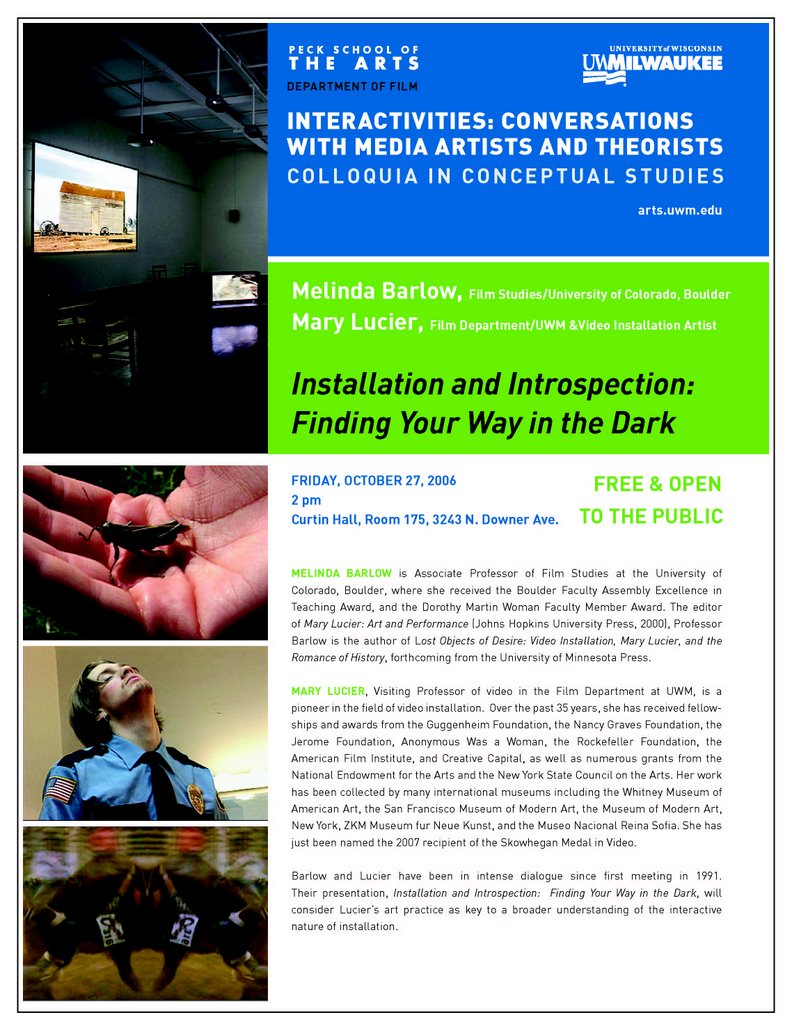
Installation and Introspection:
Finding Your Way in the Dark
10/27/2006

The second installment of this year’s Colloquia series “Interactivities: Conversations with Media Artists and Theorists” was presented on Friday, October 27th at the University of Wisconsin in Milwaukee by widely acclaimed installation artist and pioneer Mary Lucier and film scholar Melinda Barlow, from the University of Colorado in Boulder.

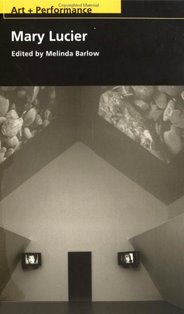
Barlow is a researcher of Mary Lucier’s work, having edited the book Mary Lucier
(PAJ Books: Art + Performance), a compilation of writings by and about Lucier, as well as drawings and ephemera surrounding the artist’s projects. She is also the author of the forthcoming “Lost Objects of Desire: Video Installation, Mary Lucier and the Romance of History”, to be published by the University of Minnesota Press.

Barlow introduced the subject of video installations by pointing out the contradictory nature of installation art, as an ambivalent media that offers, on one hand, the materiality of an environment that engages the audience in a concrete and tactile experience and, on the other, the impermanence of ephemeral objects – a consequence of the transient nature of most such work, displayed only temporarily at any given location. To illustrate this, Barlow paraphrased the California-based scholar Margaret Morse, stating that, when installation art is concerned, “you had to be there”.

“Being there” is in the core of the interactive essence of video installations. Throughout the presentation both Barlow and Lucier presented rich documentation of some of Lucier’s projects,
including “Asylum, a Romance” (1986), “Oblique House” (1993) and the never realized “Portrait of Rosa Mendez” (1974). With very few exceptions - such as “Dawn Burn” (1975), currently in the permanent collection of the Museum of Modern Art in San Francisco - most of the work discussed is unavailable for visitation, which means we must rely on the paper and image trail left by the artist and compiled and analyzed by the scholar. Melinda Barlow’s evocative writing and description of Mary Lucier’s pieces appears as an appealing alternative to the impermanence of the work, making the artist-scholar dialogue particularly relevant and enlightening, in this context.

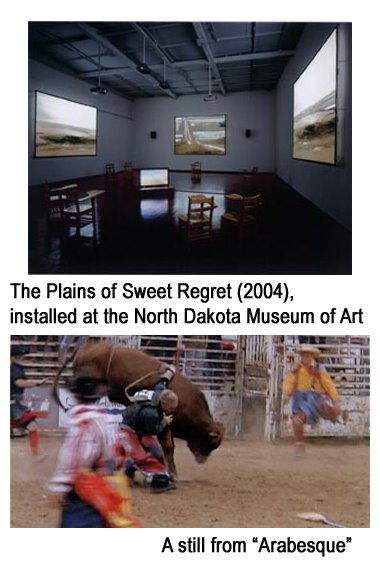
Lucier closed the presentation by showing the kaleidoscopic finale of “The Plains of Sweet Regret” (2004), an installation originally commissioned by the North Dakota Museum of Art.
As beautifully edited and touching as the now single-channel piece “Arabesque” is, Barlow is quick to remark that watching its projection is “nowhere near the experience of being in the space”, where it was shown in four large video projection screens and two 43” plasma monitors, with Lucier’s multi-layered version of George Strait’s song “I Can Still Make Cheyenne” reverberating from four loudspeakers.

The travel-inclined colloquia audience can take comfort in the fact that “The Plains of Sweet Regret” is currently installed at the University of Michigan Museum of Art in Ann Arbor (until November 19th) and will be shown at Lennon, Weinberg, Inc. in New York city from March 10th to April 28th, 2007.
A website about the project including an inspired essay by Laurel Reuter is also available at http://www.ndmoa.com/MLsite/index.html

The Colloquia with Mary Lucier and Melinda Barlow was a unique opportunity to watch the interaction of artist and scholar and how blurry these boundaries become when both parties are so deeply invested in the work. Mary Lucier is clearly an intellectual herself, while Barlow’s descriptions are meant to be an “evocation” of her pieces. “[Lucier’s work] gives me permission and freedom to be lyrical”, she says.

It seems to me that the presentation last Friday was led by a practice-scholar and a theory-poet, and it wasn’t always easy to tell which was which. Like with video installation in general and Mary Lucier’s work in particular, “you just had to be there”.

- - - - - - - - - - - - - - - - - - - - - - - - - - - - - - - - - - - - - -

On a side note, a remarkable complement to the Colloquia was to see Mary Lucier in action at the Milwaukee Art Museum, where, over the weekend, the artist shot her next performance / video installation. Lucier installed three cameras in Windhover Hall, the lobby of Santiago Calatrava-designed’s Quadracci Pavilion in order to capture “the changing light and mood in this space as she videotapes visitors’ interactions with the site”.
A test video preview of Lucier’s work at the MAM can be found at http://www.mam.org/exhibitions/lucier_shoot2.htm

Wednesday, October 25, 2006

Conceptual Studies In Action!


Want to see more of the exciting student work being done in the
Conceptual Studies program at UWM?
Click here

"Interactivities": Mary Lucier and Melinda Barlow


Just a quick word about our next presentation in the colloquia series, Interactivities. I am very excited about this event since it brings together in conversation Mary Lucier, a video/installation artist currently teaching at UWM, and Melinda Barlow, a film theorist/critic at the University of Colorado-Boulder. This is the kind of dialogue the Conceptual Studies crew lives for since we believe strongly not only in the collaborative process but also in the intersection of creative and critical practice. There is a long standing and esteemed tradition in the cinema of the merger of theory/practice (e.g., in the work of Jean Epstein, Germaine Dulac, Dziga Vertov not to mention their contemporary counterparts in Jean-Luc Godard, Anne Marie Mieville, and within the new media world, Carroll Parrott Blue, Lev Manovich, and Norman Klein). Nonetheless, there is also a counter narrative in media discourse that would have us believe that these things exist only in isolation from each other or are best understood only through highly specialized training. Such a view undercuts the very radicality that visual thinking/writing represented -- a "language" whose open form escapes the confines of institutionalized speech/discourse. In some ways, the idea of interactivity is already in place once the image is initiated as the primary instrument of "interface" for us. Certainly images can be "read" or manipulated and framed to produce a "passive" response, but images and especially moving images begin with an uncanny gesture toward the past, present, and future simultaneously. It is in that moment of the now/not quite now that opens the image to the viewer and draws us into an opportunity for "interactivity." Hope to see you at the colloquia, DJ Zoe Trop (aka V. Callahan)

October 27, 2006 Colloquia: Mary Lucier and Melinda Barlow

Sunday, October 15, 2006

BFA in Film, Conceptual Studies Track at UWM

The Department of Film in the Peck School of the Arts offers three integrated tracks of study leading to a BFA in Film Production, with an emphasis on the following:

Film/Video/New Genres
Conceptual Studies in Media Arts Production
Photography

The Conceptual Studies in Media Arts Production Track of the BFA degree in Film offers a rigorous course of study in media arts theory, history, and criticism thoroughly integrated with production in film, video, new genres and photography within courses and across the curriculum.

Click here to download the course requirements for the Conceptual Studies track.

Monday, October 09, 2006

Colloquia- 10/9/06

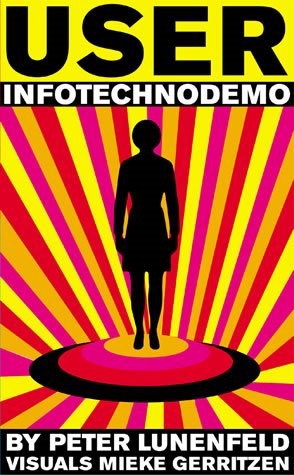
On Monday October 9th, the University of Wisconsin Milwaukee was honored to welcome digital media critic and theorist Peter Lunenfeld as the first speaker of the university conceptual film department’s annual colloquia series. Lunenfeld, author of USER: InfoTechnoDemo, used the two hours to explain his thoughts on technology today, discuss how it now goes hand in hand with literature, and then went on to show a number of examples that display this theory.
The first main point Lunenfeld tried to explain was how our culture has stopped dead in its tracks when it comes to visions about the future. His example was the film Blade Runner, which (in 1982), showed a futuristic world that would mold this image into society’s head of what people had to look forward to. He explained how films such as The Matrix display this same futuristic world, twenty years later, with only subtle differences existing between the two.


Lunenfeld, who is also an avid worker on the Mediawork Project (http://mitpress.mit.edu/e-books/mediawork/) explained that while this futuristic world is not at all like the one that has been imagined for many years, it has changed to the extent that technology goes hand in hand with media that never would have been considered as such, but more so that the use of this technology to (as he stressed) enhance and not replace these media by allowing the user some interactivity with them. The examples given on the website above explore this idea, with the use of interactive reading (choosing the way a story is going to mold), or even through just having the text scroll different ways, making the reader investigate the way they view a certain type of medium.


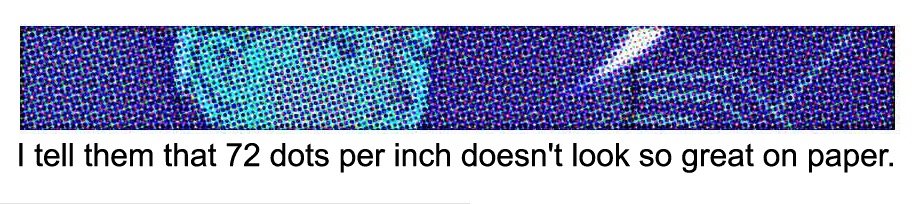
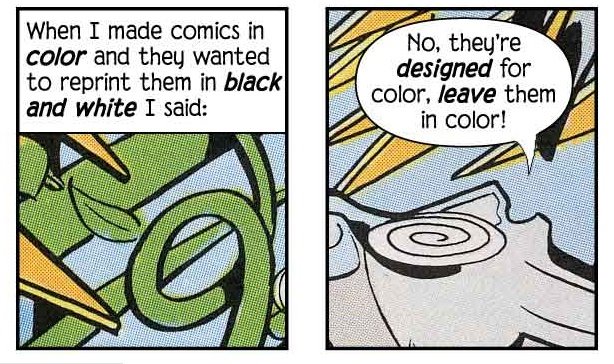
Editorial note by Conceptual Studies: We've added some "visual aids" here. The last two images come from Scott McCloud's "webtake" response to Brenda Laurel's equally inspired "Utopian Entrepreneur." Visit the link given above to read through Laurel's and McCloud's pieces in their entirety.

Saturday, October 07, 2006


The Colloquia in Conceptual Studies are intended as a forum in which to interrogate and initiate new models of media theory, history, and practice. This year, in focusing on interactive media, we will present some of the leading media artists, scholars, and critics shaping the forms and discourse of contemporary culture today. The idea of interactivity, often understood as a given of the digital age, will be examined from a variety of perspectives as we address dimensions of interactivity that include video installation, audio art and music, dance, interactive cinema, and gaming. Appropriate to the topic, the colloquia will feature a number of presentations that explicitly engage an active dialogue between an artist and media theorist/historian. Lectures are free and open to the public. Interactivities has been co-programmed by Mary Lucier and Vicki Callahan.
[Image from: Bob's Palace, by Luc Vanier]

Thursday, October 05, 2006

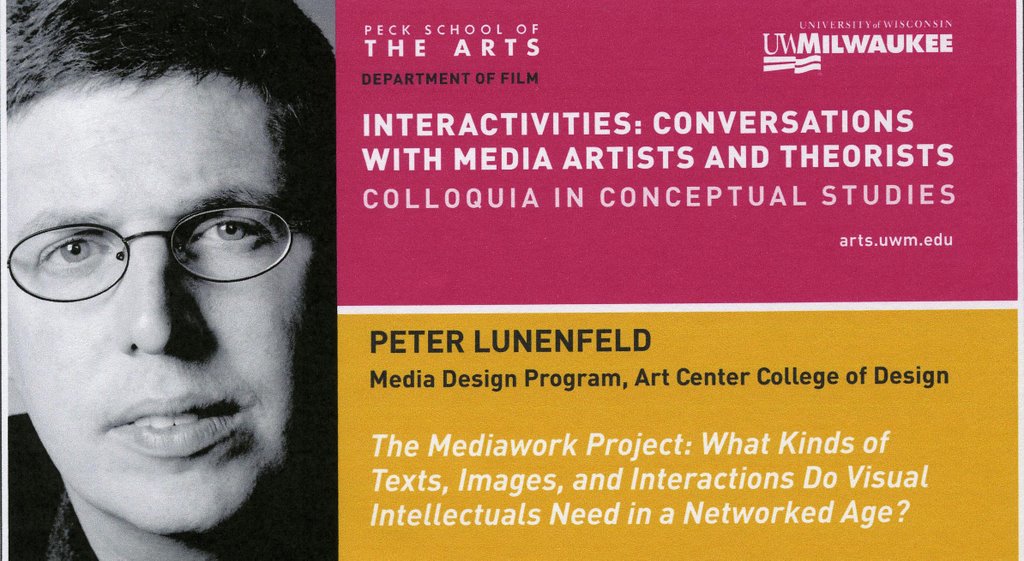
Peter Lunenfeld at UWM's Colloquia in Conceptual Studies, October 9, 2006


PETER LUNENFELD’s presentation for the colloquia, The Mediawork Project: What Kinds of Texts, Images, and Interactions do Visual Intellectuals Need in a Networked Age? addresses the emergence of visual intellectuals—people simultaneously making, pondering, and commenting on culture in a way that doesn’t always begin with words. He discusses how to develop strategies to make the dissemination of critical thinking both more seductive and more rigorous to geeks and technophobes, artists and art historians, MBA’s and scientists alike.

PETER LUNENFELD is a writer and critic specializing in the history and theory of media technologies and a member of the Core Faculty of the Media Design Program at Art Center College of Design. He holds a BA from Columbia University, an MA from SUNY at Buffalo, and a PhD from UCLA. Peter founded Mediawork: the Southern California New Media Working Group. He serves as Director of the Institute for Technology & Aesthetics (ITA), is the author of USER (MIT, 2004) and Snap to Grid: A User’s Guide to Digital Arts, Media & Cultures (MIT, 2000). He is the editor of The Digital Dialectic: New Essays in New Media (MIT, 1999) and the editorial director for the Mediawork Project, a pamphlet series, from MIT Press. Mediawork pamphlets explore art, literature, design, music, and architecture in the context of emergent technologies and rapid economic and social change. They can be described as being somewhere in-between ‘zines for grown-ups and transmedia theoretical fetish objects.

Monday, October 02, 2006

An Overall Description of the Sophie demonstration

On the evening of October 2, 2006, Virginia Kuhn of USC came to the University of Wisconsin Milwaukee to demonstrate a program that was released that very morning- Sophie. Sophie is an updated program of TK3, an interactive open source program that brings together iMovie and Powerpoint. With this combination, a user has the ability to format their presentation in either timeline or page form, allowing the presentation to be viewed as either a book or a film. Kuhn introduced the program as such, stressing the importance of linking digital visuals to text in the 21st century, and how the combination of these two can blend for an ideal format for dissertations, etc.
Kuhn first showed the group examples of projects created on TK3, as the program is very similar to the Sophie program, with a few exceptions. The first was a dissertation on Middle-Eastern Americans. By scanning the project, Kuhn demonstrated how TK3 has the ability to create a table of contents with hyperlinks, to take you to the desired section of the paper, as well as page turning options similar to those on Adobe Reader. The project displayed the program’s video capabilities, the option to create annotations for reference capabilities, a notebook window for readers to comment on the project being viewed, and a word finding option, just to display a view. This first project showed TK3/Sophie’s ability to create a project similar to something out of an interactive encyclopedia. Following, Kuhn tried displaying a storybook movie project someone had created, but because all the files were not present, the project was not viewable. Last was a film by John Berger, showing the program’s ability to either fullscreen a video, or surround it by text before viewing.
A video done by TK3 creator Bob Stein took over from here, demonstrating how Sophie worked. The short film demonstrated the program’s text field sizing abilities, the concept behind the timeline option in the program (the program can have an unlimited number of timelines and pages), the ability to scroll through the pages or go through them from the hyperlinks, and overall just how simple using the program was. The project created for the demo was a slideshow with Beethoven’s 5th symphony.
While the demonstration was informational in many ways, it moved incredibly too fast for the group, which is why Kuhn followed up with a full demonstration on how the program worked. It was at this point that many of the glitches of the program were pointed out to the group. However, Kuhn pointed out that because the program is so new, using it is a learning experience for everyone, including the creators, and any problems with the program should be addressed by sending an email to the help staff.
Overall, Sophie looks to be a promising new program that will hopefully one day replace Powerpoint and iMovie. While many questions and suggestions were shot out at the session, it was evident that the group was very excited about learning the new software, as seen from the hands-on workshop that followed the lecture. The program’s click and drag options make the program simple enough to use for most people, the only criticism most had was the program’s inability to open a new book by itself. The University of Wisconsin Milwaukee thanks Ms. Kuhn for her time this evening with the lecture and demonstration of Sophie.

Sophie workshops: Monday and Tuesday


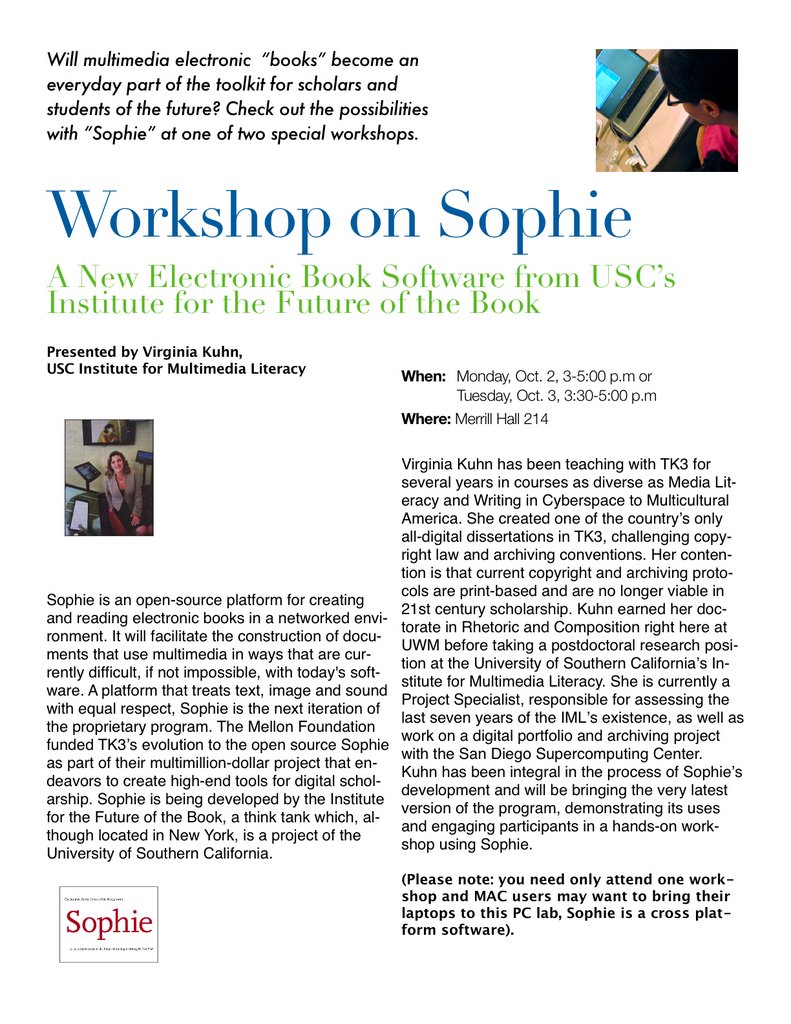
Will multimedia electronic “books” become an everyday part of the toolkit for scholars and students of the future? Check out the possibilities with “Sophie” at one of two special workshops.

Workshop on Sophie: A New Electronic Book Software from USC’s Institute for the Future of the Book

Presented by Virginia Kuhn, USC Institute for Multimedia Literacy

When:
Monday, Oct. 2, 3-5:00 p.m or
Tuesday, Oct. 3, 3:30-5:00 p.m
Where:
Merrill Hall 214, UWM campus

Sophie is an open-source platform for creating and reading electronic books in a networked environment. It will facilitate the construction of documents that use multimedia in ways that are currently difficult, if not impossible, with today's software. A platform that treats text, image and sound with equal respect, Sophie is the next iteration of the proprietary program. The Mellon Foundation funded TK3’s evolution to the open source Sophie as part of their multimillion-dollar project that endeavors to create high-end tools for digital scholarship. Sophie is being developed by the Institute for the Future of the Book, a think tank which, although located in New York, is a project of the University of Southern California.

Virginia Kuhn has been teaching with TK3 for several years in courses as diverse as Media Literacy and Writing in Cyberspace to Multicultural America. She created one of the country’s only all-digital dissertations in TK3, challenging copyright law and archiving conventions. Her contention is that current copyright and archiving protocols are print-based and are no longer viable in 21st century scholarship. Kuhn earned her doctorate in Rhetoric and Composition right here at UWM before taking a postdoctoral research position at the University of Southern California’s Institute for Multimedia Literacy. She is currently a Project Specialist, responsible for assessing the last seven years of the IML’s existence, as well as work on a digital portfolio and archiving project with the San Diego Supercomputing Center. Kuhn has been integral in the process of Sophie’s development and will be bringing the very latest version of the program, demonstrating its uses and engaging participants in a hands-on workshop using Sophie.

(Please note: you need only attend one workshop and MAC users may want to bring their laptops to this PC lab, Sophie is a cross platform software).

for more on Sophie go to: http://www.futureofthebook.org/

Sunday, October 01, 2006

Welcome to Conceptual Studies at UWM

Welcome to the blog for Conceptual Studies in the Department of Film at the University of Wisconsin at Milwaukee.

Coming very soon: news of the 2006-2007 Colloquia in Conceptual Studies. This year's topic is "Interactivities: Conversations with Media Artists and Theorists." Schedule is as follows:

_______________

Monday October 9, 6-9pm (MIT B91)
Peter Lunenfeld (Professor, Media Design Program, Art Center College of Design)
Title: “The Mediawork Project: What Kinds of Texts, Images, and Interactions Do Visual Intellectuals Need in a Networked Age?”

Friday October 27, 2-5pm (CRT 175)
Mary Lucier (Visiting Professor, Film Department/UW-Milwaukee; Video Installation Artist) and Melinda Barlow (Associate Professor of Film Studies at the University of Colorado, Boulder)
Title: “Installation and Introspection: Finding Your Way in the Dark”

Friday November 10, 2-5pm (CRT 175)
NOTE: THIS HAS BEEN RESCHEDULED FOR APRIL 6, 2007
Susana Ruiz (USC School of Cinema-Television, Division of Interactive Media)
Title:“Merging Gravity and Play: A Case Study"

Friday, December 8, 2-5pm (CRT 175)
Grahame Weinbren (Professor, School of Visual Arts; Editor, Millennium Film Journal; Interactive Media Artist)
Title: "In the Ocean of Streams of Story."